Every Breath Counts: Why Faulty Breathing Patterns Are Undermining Spokane's Athletes and Desk Workers
It is easy to take breathing for granted. The body does it automatically, around the clock, without conscious instruction. Yet respiratory mechanics — the specific mechanics of how air moves in and out of the body — vary considerably from person to person, and those variations carry real consequences for physical health, pain levels, and performance capacity.
At our center, we encounter patients across a wide spectrum: competitive runners training along the Centennial Trail, cyclists preparing for summer routes through the Palouse, and professionals spending eight or more hours daily in front of a screen. What frequently surprises both groups is learning that their breathing patterns may be contributing directly to the symptoms that brought them through our door.
What Shallow Breathing Actually Means
Shallow breathing — sometimes called chest breathing or thoracic breathing — refers to a pattern in which the upper chest does the majority of the respiratory work. The ribcage lifts, the shoulders may rise slightly, and only the upper portion of the lungs fills with air. The diaphragm, which is the primary muscle of respiration, remains largely underutilized.
This matters for several reasons. The lower lobes of the lungs contain the highest concentration of oxygen-absorbing tissue and the greatest density of blood vessels available for gas exchange. When breathing remains persistently shallow, the body achieves adequate ventilation but not optimal oxygenation. Over time, this inefficiency compounds.
For athletes, the consequence tends to show up as earlier-than-expected fatigue, reduced endurance, and a sensation of breathlessness that seems disproportionate to effort level. For sedentary workers, the consequences are less dramatic but equally disruptive: persistent tension across the upper back and neck, frequent headaches, reduced mental clarity, and a low-grade state of physiological stress that never fully resolves.
How Modern Life Rewires Respiratory Mechanics
Dysfunctional breathing rarely develops overnight. It emerges gradually through accumulated postural and behavioral habits — many of which are deeply embedded in contemporary life.
Consider the standard office setup. A worker seated for several hours tends to adopt a forward head position, rounded shoulders, and a compressed thoracic spine. In this posture, the diaphragm's range of motion is mechanically restricted. The body compensates by recruiting secondary respiratory muscles in the neck, shoulders, and upper chest. These muscles — designed primarily for postural support and emergency breathing during exertion — are not built for sustained use as primary breathing drivers. The result is chronic muscular overload in precisely the areas where office workers most commonly report pain.
Athletes face a different but related challenge. High-intensity training can reinforce chest-dominant breathing patterns if technique is never addressed. A runner who habitually breathes into the upper chest may be leaving meaningful aerobic capacity on the table. More concerningly, poor breathing mechanics can disrupt the core stability system, since the diaphragm plays a central role in intra-abdominal pressure regulation — a function essential for spinal support during dynamic movement.
Stress physiology adds another layer. Shallow, rapid breathing activates the sympathetic nervous system, the branch responsible for the body's fight-or-flight response. For many Spokane residents managing demanding work schedules, family obligations, and the general pace of modern life, this activation has become a near-constant background state. The breathing pattern both reflects and perpetuates that state, creating a cycle that is difficult to interrupt without deliberate intervention.
Recognizing Dysfunctional Breathing in Yourself
A straightforward self-assessment can offer initial insight. Place one hand on the chest and one on the abdomen just below the navel. Take a normal breath without attempting to alter it. Observe which hand moves first and which moves more.
In optimal breathing mechanics, the abdomen expands first and most prominently on inhalation, reflecting downward diaphragmatic movement. The lower ribcage widens laterally. The upper chest remains relatively still. If the chest hand rises first, or if the abdomen barely moves at all, chest-dominant breathing is likely the predominant pattern.
Additional indicators include a tendency to sigh frequently, habitual breath-holding during concentration, noticeable shoulder elevation when breathing deeply, and a resting breathing rate consistently above 15 to 18 breaths per minute.
Practical Techniques to Restore Respiratory Function
Restoring functional breathing mechanics is achievable and does not require specialized equipment. The following approaches are appropriate starting points for both athletes and sedentary workers.
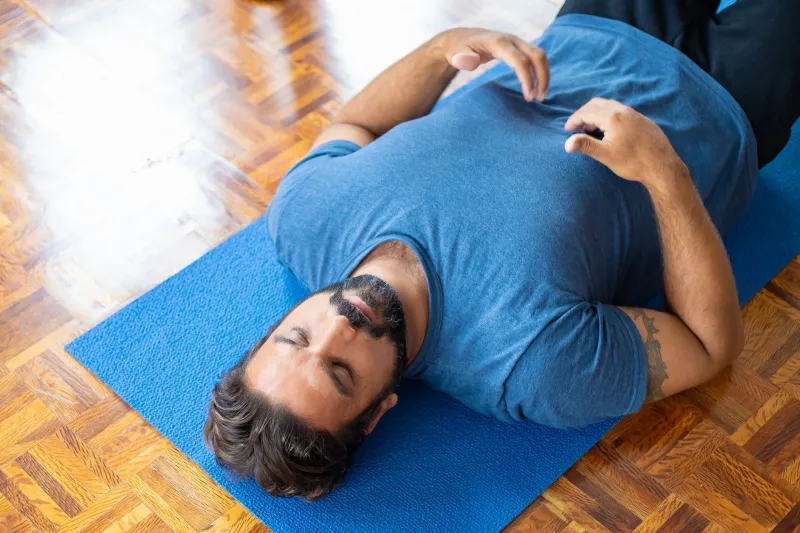
Diaphragmatic Breathing Practice Begin in a comfortable supine position with knees bent. Place one hand on the chest and one on the abdomen. Inhale slowly through the nose for a count of four, directing the breath so that the abdominal hand rises while the chest hand remains still. Exhale fully through the nose or pursed lips for a count of six. Practice this for five to ten minutes daily. Consistency matters more than duration in the early stages.
Lateral Ribcage Expansion Place both hands along the sides of the lower ribcage with fingers pointing forward. On inhalation, focus on expanding the ribcage outward into the hands in a 360-degree pattern. This technique helps activate the full circumferential movement of the diaphragm and is particularly useful for individuals with chronically compressed thoracic spines.
Nasal Breathing During Low-Intensity Exercise For athletes, committing to nasal-only breathing during easy training sessions — walks, light jogs, recovery rides — provides a structured way to reinforce diaphragmatic mechanics under mild cardiovascular demand. Nasal breathing also promotes nitric oxide production, which supports vasodilation and improved oxygen delivery to working muscles.
Postural Awareness Breaks For office workers, integrating brief postural resets every thirty to forty-five minutes can reduce the mechanical restriction that drives chest-dominant breathing. A simple reset involves sitting tall, rolling the shoulders back and down, and taking three deliberate diaphragmatic breaths before returning to work. The cumulative effect across a full workday is more significant than it may initially appear.
When Professional Evaluation Is Warranted
Self-directed breathing retraining is beneficial for many individuals, but certain presentations benefit from formal clinical assessment. Persistent shortness of breath, chest tightness, or breathing irregularities unrelated to exertion should always be evaluated by a qualified healthcare provider to rule out underlying cardiopulmonary conditions.
For patients whose breathing dysfunction is intertwined with chronic pain patterns, postural imbalances, or movement limitations, a structured rehabilitation program that integrates respiratory retraining with manual therapy and corrective exercise tends to produce more durable outcomes than breathing exercises alone.
A Foundation Often Overlooked
Respiration is the most fundamental of physiological processes. It underpins energy production, nervous system regulation, core stability, and stress resilience. Yet it remains one of the least examined aspects of both athletic training and workplace wellness in Spokane and beyond.
At Be At Hand in Spokane, we encourage patients to approach breathing not as a passive background function but as a trainable skill with meaningful implications for daily health. Whether the goal is improved performance on race day or simply arriving home from the office without a tension headache, restoring functional breathing mechanics is a practical, evidence-informed place to begin.